
What's the difference between running an engine on an engine-dyno, or, as installed in the car, on a chassis-dyno?
Most chassis dynos extrapolate an engine's power and torque based on vehicle inertia. Many variables can affect chassis dyno results. It's a great convenient tuning aid, but you can't directly equate the reported torque and power numbers back to engine dyno results, or even the results obtained from two different chassis dynos. Operator experience is critical for obtaining consistent results from small incremental changes.
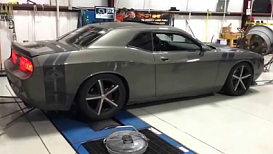
If you want to know how the engine will run in the real world as-installed in your vehicle and/or determine overall drivetrain performance and efficiency, then the chassis-dyno is the better choice. However, it doesn't directly measure torque. Instead it extrapolates output according to the chassis dyno manufacturer's software logic. Also it's harder to get back-to-back repeatability on even the same chassis-dyno, so expect at least a 5% variance in otherwise-identical back-to-back runs. Simply put, there's greater variance in results from different chassis-dynos then there are on two different, but properly calibrated and corrected, engine dynos.
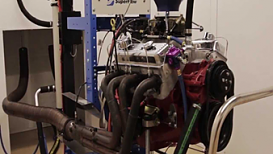
However, if you want big, accurate numbers, in a carefully controlled environment, the engine dyno is the way to go. Engine dynos directly measures true torque at the flywheel, so it will tell you how much power the engine makes in a perfect world. A properly controlled engine dyno cell, a carefully calibrated engine dyno, and a good operator is capable of test repeatability within 1%.
Here are some “take-aways” when you compare a chassis to an engine dyno:
Most chassis dynos extrapolate an engine's power and torque based on vehicle inertia. Many variables can affect chassis dyno results. It's a great convenient tuning aid, but you can't directly equate the reported torque and power numbers back to engine dyno results, or even the results obtained from two different chassis dynos. Operator experience is critical for obtaining consistent results from small incremental changes.
If you want to know how the engine will run in the real world as-installed in your vehicle and/or determine overall drivetrain performance and efficiency, then the chassis-dyno is the better choice. However, it doesn't directly measure torque. Instead it extrapolates output according to the chassis dyno manufacturer's software logic. Also it's harder to get back-to-back repeatability on even the same chassis-dyno, so expect at least a 5% variance in otherwise-identical back-to-back runs. Simply put, there's greater variance in results from different chassis-dynos then there are on two different, but properly calibrated and corrected, engine dynos.
However, if you want big, accurate numbers, in a carefully controlled environment, the engine dyno is the way to go. Engine dynos directly measures true torque at the flywheel, so it will tell you how much power the engine makes in a perfect world. A properly controlled engine dyno cell, a carefully calibrated engine dyno, and a good operator is capable of test repeatability within 1%.
Here are some “take-aways” when you compare a chassis to an engine dyno:
- Engine dynos are best for accurate and repeatable measurement of an engine's actual torque and horsepower numbers at the flywheel.
- Chassis dynos are a great in-car tuning tool but can't be relied on for highly accurate and repeatable power and torque measurements.
- With an automatic transmission, experts claim a 25-27% horsepower loss on a chassis-dyno versus an engine dyno.
- With a manual transmission, experts claim a 15-17% horsepower loss on a chassis-dyno versus an engine-dyno.
- Many variables affect chassis dyno accuracy, but all these "little" things affect the results and the amount of power-drop compared to flywheel numbers.
- Engine-driven mechanical fans cost power.
- Wheel weight, tire size and weight, and how fast you are accelerating that tire/wheel mass can drastically change a chassis-dyno's recorded results. Then there's airflow through the engine compartment, oil and coolant temperatures, inlet air temps, air cleaner size, the effect of engine-driven accessories, airflow quality through the engine compartment with the hood shut, how tight the dyno's tie down restraints are, etc.