
The Trans-Am Series was created in 1966 by the Sports Club of America (SCCA). Originally known as the Trans-American Sedan Championship, the name was changed to the Trans-American Championship for 1967. The series has in fact gone by a variety of different names through the years (too many to list), some linked to sponsors, some not. It has evolved over time from its original format as a Manufacturers' Championship series for modified passenger sedans and coupes to its current form as a Drivers'/ Manufacturers' Championship Series that is open to GT- style racecars. Champion drivers have been officially recognized, and Drivers' Championships awarded since the 1972 season.
The first successful Trans-Am racers were Jerry Titus, who drove a 1968 Mustang, and Mark Donahue who drove a 1967-1970 Camaro and 1971 Javelin.
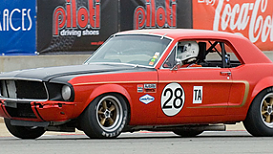
1968 Mustang (Jerry Titus)
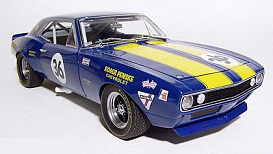
1967 Camaro (Mark Donahue)
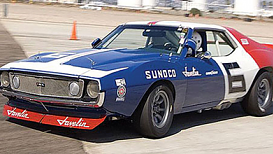
1971 AMC Javelin (Mark Donahue)
Not to be left behind, Dodge and Plymouth jumped into Trans-Am racing in 1970, with its E-body Challenger T/A and ‘Cuda AAR models, equipped with the new 305 Six-Pack engine. Driving these cars was Sam Posey, Dan Gurney and Swede Savage.
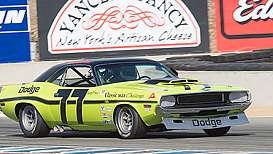
1970 Challenger T/A (Sam Posey)
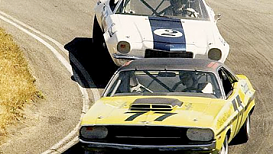
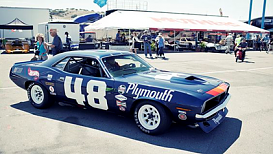
Dan Gurney and Swede Savage- ‘Cuda AAR
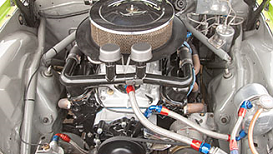
305 Cubic Inch Mopar Trans-Am engine
To qualify for Trans-Am racing, Plymouth and Dodge had to sell 2,400 (each) 1970 Plymouth AAR ‘Cuda and Challenger T/A models. Both were equipped with a 290 hp. 340 cubic inch Six-Pack engine that used the stronger 305 cubic inch racing block (Note- Trans-Am was cast right onto the side of it). It also featured an Edelbrock intake with 3 Holley 2-barrel carburetors. Fresh air was fed through a light weight fiberglass hood which was finished in satin black to eliminate glare. The suspension and steering were upgraded. One of the coolest features was the side exit exhaust. The factory also used staggered size tires to raise the back for exhaust clearance.
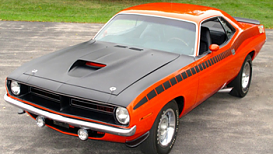
1970 AAR ‘Cuda
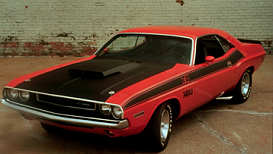
1970 Challenger T/A
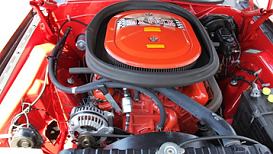
340 Six-Pack, 290 hp. Engine
Over the years, the series has raced on a variety of race tracks (permanent and temporary road courses/street circuits/airport circuits) all over the country, as well as at venues in Canada, Mexico, and even San Juan, PR, in 2003. Since 2015, Trans Am has been a national series (continental U.S. only), racing at tracks primarily throughout the East Coast, South, and Midwest. In 2017, the new stand-alone West Coast Championship was added to the Trans Am Series. Currently, there are six races on the schedule, two of which are joint, or "shared" races with the national Championship series, in which drivers from both championship series race together in the same races, but only earn points in the championship series that they are entered in.
Two classes of cars compete in the series- TA and TA2.
TA class cars are high-performance Grand Touring race cars with a tubular chassis and a Cadillac CTS-V, Chevrolet Camaro / Corvette, Dodge Challenger, or Ford Mustang body (full-scale replica) built by Advanced Composite Products (all eligible cars except Corvette C7) or Derhaag Motorsports (Corvette C6, C7 / Camaro Gen 6 only). All body types are eligible from the first year of production of the street car to 5 years after production ends. After each body model's full eligibility ends, each body will be partially eligible for an additional 5 years, and may be used in up to five races per year of eligibility.
Power comes from overhead valve (two per cylinder), pushrod, naturally-aspirated, carbureted 366 cubic inch (5.99 L) V8 engines producing 850+ horsepower. The minimum base weight is 2,850 lbs. Current rules allow for the use of leaded gasoline, whereas all other classes must use unleaded gas. Automatic transmissions are prohibited, and manual transmissions must have no more than five forward gear ratios, as well as a functional reverse gear. Sequential shifting transmissions are permitted, as well as commercially available No-Lift Shift (NLS) systems, and also "auto-blip" RPM matching systems for downshifting. Traction Control devices or systems that function independently of the driver are strictly prohibited, as is ABS (Anti-skid Braking System).
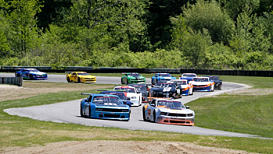
In a reflection of the ongoing muscle car battle for supremacy that has raged for nearly 50 years, transcending tracks, showrooms and garages across America, Trans Am created the TA2 class, powered by AEM. With car counts regularly in the 30s, TA2 is the hottest class in road racing. It combines the prowess of a purpose-built racing platform, tailored to the grueling conditions of sprint format racing, with relevant manufacturer power plants and the unmistakable silhouettes of today’s muscle cars. TA2 represents the best value platform in racing, with engines capable of lasting an entire season and cost control measures that allow drivers to fully focus on racing, not the financing of it, while showcasing their talents and skill.
TA2 class rules specify a tubular chassis built by Howe Racing Enterprises, Mike Cope Racing, M-1 Motorsports, or Meissen Enterprises, and a Chevrolet Camaro, Ford Mustang or Dodge Challenger (full-scale replica) built by either Five Star Racing Race Car Bodies (Gen 6 Camaros / Mustangs), or Howe Racing Enterprises (all other eligible cars), with the Camaro body being the most popular by far. Specific to the TA2 class, two functional brake lights in their approximate stock locations are required, and one must be functional any time the car is on track. Likewise, two functional taillights/rain lights are also required. The minimum base weight (including driver and any driver gear) for all cars is 2,830 pounds. The costs of shock absorbers, brake calipers & pads, and wheels are controlled, and no titanium or carbon fiber components are allowed. Only the driver's seat and rear wing may be constructed using carbon fiber.
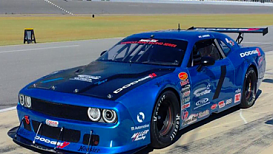
Cameron Lawrence (Dodge’s first Trans Am Championship- 2014)
TA2 engines are similar to TA engines, but they use fuel injection rather than a carburetor. They must use intake restrictor plates, as maximum power is limited to 490 hp. and 447 lb-ft of torque. As per current rules, "Nothing may direct or force air to the filter or housing." Transmissions must be commercially available, "H pattern" manual units with four forward gear ratios (1:1 fourth gear ratio, and no overdrive) and a reverse gear. Sequential shift mechanisms are not allowed, nor are shift-without-lift mechanisms. Traction Control devices or systems that function independently of the driver are strictly prohibited, as is ABS (Anti-skid Braking System).
The TA2 racecar is a purpose-built racing machine. Designed, built and tuned with only one thing in mind- performance. With engines restricted to just under 500 hp., longevity is promoted while not sacrificing performance. So, although a TA2 race car is built on a cost effective platform, it still produces speeds that are more than capable of raising eyebrows.

Cost Control Specifications
Keeping the TA2 class the high performance, low cost platform it was founded upon, is important to Trans Am and its drivers. The following constitute the cost control measures:
Shock Absorbers - $850 each
Brake Calipers - $550 each
Brake Pads- $250 per axle
Wheels – $175 each
Headers - $1,850 a set
Complete Exhaust System - $2,200
No titanium or carbon fiber components are allowed, aside from the driver’s seat.
Bodies
Bodies must be either a Dodge Challenger, Ford Mustang, or a Chevrolet Camaro. The following is a list of those bodies and approved manufacturers:
Dodge Challenger (Howe Racing Enterprises)
Chevrolet Camaro (Five Star RaceCar Bodies)
Ford Mustang (Five Star RaceCar Bodies)
Rear Wing
Cars must be outfitted with a properly installed Derhaag single plane rear wing.
Approved Chassis Producers
Howe Racing Enterprises 989-435-7080
Mike Cope Racing 727-201-8910
Meissen Engineering 815-962-0053
Engines
There are several engine packages available- all of which are directly competitive with one another.
Primary Engine and Parts Suppliers
Dodge Hemi: Prefix
GM LS3: Schwanke Engines
Ford: Koury Race Engines
Approved Engine Builder/Rebuilders
PREFIX - Dodge Hemi
Brand Racing Engines - GM LS3
Flow Tech Racing - GM LS3, Ford
Katech - GM LS3, Ford
Koury Race Engines - Ford
Schwanke Engines - GM LS3
Wegner Motorsports - GM LS3, Ford
The first successful Trans-Am racers were Jerry Titus, who drove a 1968 Mustang, and Mark Donahue who drove a 1967-1970 Camaro and 1971 Javelin.
1968 Mustang (Jerry Titus)
1967 Camaro (Mark Donahue)
1971 AMC Javelin (Mark Donahue)
Not to be left behind, Dodge and Plymouth jumped into Trans-Am racing in 1970, with its E-body Challenger T/A and ‘Cuda AAR models, equipped with the new 305 Six-Pack engine. Driving these cars was Sam Posey, Dan Gurney and Swede Savage.
1970 Challenger T/A (Sam Posey)
Dan Gurney and Swede Savage- ‘Cuda AAR
305 Cubic Inch Mopar Trans-Am engine
To qualify for Trans-Am racing, Plymouth and Dodge had to sell 2,400 (each) 1970 Plymouth AAR ‘Cuda and Challenger T/A models. Both were equipped with a 290 hp. 340 cubic inch Six-Pack engine that used the stronger 305 cubic inch racing block (Note- Trans-Am was cast right onto the side of it). It also featured an Edelbrock intake with 3 Holley 2-barrel carburetors. Fresh air was fed through a light weight fiberglass hood which was finished in satin black to eliminate glare. The suspension and steering were upgraded. One of the coolest features was the side exit exhaust. The factory also used staggered size tires to raise the back for exhaust clearance.
1970 AAR ‘Cuda
1970 Challenger T/A
340 Six-Pack, 290 hp. Engine
Over the years, the series has raced on a variety of race tracks (permanent and temporary road courses/street circuits/airport circuits) all over the country, as well as at venues in Canada, Mexico, and even San Juan, PR, in 2003. Since 2015, Trans Am has been a national series (continental U.S. only), racing at tracks primarily throughout the East Coast, South, and Midwest. In 2017, the new stand-alone West Coast Championship was added to the Trans Am Series. Currently, there are six races on the schedule, two of which are joint, or "shared" races with the national Championship series, in which drivers from both championship series race together in the same races, but only earn points in the championship series that they are entered in.
Two classes of cars compete in the series- TA and TA2.
TA class cars are high-performance Grand Touring race cars with a tubular chassis and a Cadillac CTS-V, Chevrolet Camaro / Corvette, Dodge Challenger, or Ford Mustang body (full-scale replica) built by Advanced Composite Products (all eligible cars except Corvette C7) or Derhaag Motorsports (Corvette C6, C7 / Camaro Gen 6 only). All body types are eligible from the first year of production of the street car to 5 years after production ends. After each body model's full eligibility ends, each body will be partially eligible for an additional 5 years, and may be used in up to five races per year of eligibility.
Power comes from overhead valve (two per cylinder), pushrod, naturally-aspirated, carbureted 366 cubic inch (5.99 L) V8 engines producing 850+ horsepower. The minimum base weight is 2,850 lbs. Current rules allow for the use of leaded gasoline, whereas all other classes must use unleaded gas. Automatic transmissions are prohibited, and manual transmissions must have no more than five forward gear ratios, as well as a functional reverse gear. Sequential shifting transmissions are permitted, as well as commercially available No-Lift Shift (NLS) systems, and also "auto-blip" RPM matching systems for downshifting. Traction Control devices or systems that function independently of the driver are strictly prohibited, as is ABS (Anti-skid Braking System).
In a reflection of the ongoing muscle car battle for supremacy that has raged for nearly 50 years, transcending tracks, showrooms and garages across America, Trans Am created the TA2 class, powered by AEM. With car counts regularly in the 30s, TA2 is the hottest class in road racing. It combines the prowess of a purpose-built racing platform, tailored to the grueling conditions of sprint format racing, with relevant manufacturer power plants and the unmistakable silhouettes of today’s muscle cars. TA2 represents the best value platform in racing, with engines capable of lasting an entire season and cost control measures that allow drivers to fully focus on racing, not the financing of it, while showcasing their talents and skill.
TA2 class rules specify a tubular chassis built by Howe Racing Enterprises, Mike Cope Racing, M-1 Motorsports, or Meissen Enterprises, and a Chevrolet Camaro, Ford Mustang or Dodge Challenger (full-scale replica) built by either Five Star Racing Race Car Bodies (Gen 6 Camaros / Mustangs), or Howe Racing Enterprises (all other eligible cars), with the Camaro body being the most popular by far. Specific to the TA2 class, two functional brake lights in their approximate stock locations are required, and one must be functional any time the car is on track. Likewise, two functional taillights/rain lights are also required. The minimum base weight (including driver and any driver gear) for all cars is 2,830 pounds. The costs of shock absorbers, brake calipers & pads, and wheels are controlled, and no titanium or carbon fiber components are allowed. Only the driver's seat and rear wing may be constructed using carbon fiber.
Cameron Lawrence (Dodge’s first Trans Am Championship- 2014)
TA2 engines are similar to TA engines, but they use fuel injection rather than a carburetor. They must use intake restrictor plates, as maximum power is limited to 490 hp. and 447 lb-ft of torque. As per current rules, "Nothing may direct or force air to the filter or housing." Transmissions must be commercially available, "H pattern" manual units with four forward gear ratios (1:1 fourth gear ratio, and no overdrive) and a reverse gear. Sequential shift mechanisms are not allowed, nor are shift-without-lift mechanisms. Traction Control devices or systems that function independently of the driver are strictly prohibited, as is ABS (Anti-skid Braking System).
The TA2 racecar is a purpose-built racing machine. Designed, built and tuned with only one thing in mind- performance. With engines restricted to just under 500 hp., longevity is promoted while not sacrificing performance. So, although a TA2 race car is built on a cost effective platform, it still produces speeds that are more than capable of raising eyebrows.
Cost Control Specifications
Keeping the TA2 class the high performance, low cost platform it was founded upon, is important to Trans Am and its drivers. The following constitute the cost control measures:
Shock Absorbers - $850 each
Brake Calipers - $550 each
Brake Pads- $250 per axle
Wheels – $175 each
Headers - $1,850 a set
Complete Exhaust System - $2,200
No titanium or carbon fiber components are allowed, aside from the driver’s seat.
Bodies
Bodies must be either a Dodge Challenger, Ford Mustang, or a Chevrolet Camaro. The following is a list of those bodies and approved manufacturers:
Dodge Challenger (Howe Racing Enterprises)
Chevrolet Camaro (Five Star RaceCar Bodies)
Ford Mustang (Five Star RaceCar Bodies)
Rear Wing
Cars must be outfitted with a properly installed Derhaag single plane rear wing.
Approved Chassis Producers
Howe Racing Enterprises 989-435-7080
Mike Cope Racing 727-201-8910
Meissen Engineering 815-962-0053
Engines
There are several engine packages available- all of which are directly competitive with one another.
Primary Engine and Parts Suppliers
Dodge Hemi: Prefix
GM LS3: Schwanke Engines
Ford: Koury Race Engines
Approved Engine Builder/Rebuilders
PREFIX - Dodge Hemi
Brand Racing Engines - GM LS3
Flow Tech Racing - GM LS3, Ford
Katech - GM LS3, Ford
Koury Race Engines - Ford
Schwanke Engines - GM LS3
Wegner Motorsports - GM LS3, Ford


