Challenger Maintenance

Automotive Cooling Systems
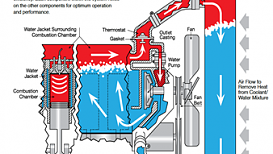
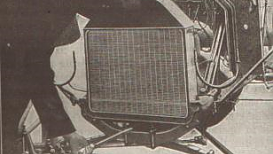
An automotive cooling system protects an engine from catastrophic failure (e.g., blown head gaskets, and warped or cracked cylinder heads or cylinder blocks ) due to overheating. Basically, it consists of the following: A series of galleries cast into the engine block and cylinder head, surrounding the combustion chambers with circulating coolant to carry away heat. A mixture of water and antifreeze in proportions appropriate to the climate. Antifreeze itself is usually ethylene glycol or propylene glycol (with a small amount of corrosion inhibitor). A radiator, consisting of many small tubes equipped with a honeycomb of fins to dissipate heat rapidly, that receives and cools hot liquid from the engine. A water pump, usually of the...
Air Conditioning
Air conditioning was first offered by Packard, in 1939, in its production cars. These units were manufactured by Bishop and Babcock Co, of Cleveland, OH. Cars ordered with the new "Weather Conditioner" were shipped from Packard's East Grand Boulevard facility to the B&B factory where the conversion was performed. Once complete, the car was shipped to a local dealer where the customer would take delivery. Packard fully warranted and supported this conversion, and marketed it well. However, it was not commercially successful and was discontinued in 1941 due to price, space constraints and technical issues. The 1953 Chrysler Imperial was one of the first production cars in twelve years to offer modern automobile air conditioning as an...
Starter Motor
Before the advent of the starter motor, engines were started by various methods including wind-up springs, gunpowder cylinders, and human-powered techniques such as a removable crank handle which engaged the front of the crankshaft, pulling on an airplane propeller, or pulling a cord that was wound around an open-face pulley. Among these methods, the hand-crank method was most commonly used to start engines, but it was inconvenient, difficult, and dangerous. The Ford Model T relied on hand cranks until 1919. The first electric starter was installed on an Arnold, built in 1896, by electrical engineer H. J. Dowsing. In 1903, Clyde Coleman invented and patented the first electric starter in America. During the 1920s, electric starters...
Charging System
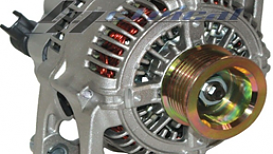
Alternators were first introduced as standard equipment on a production car by Chrysler for the Valiant model in 1960- several years ahead of Ford and General Motors. They replaced direct current generators (dynamos) because they were lighter, cheaper, more rugged and could provide a useful charge at idle speed. The present-day charging system hasn't changed much since 1960. It consists of the alternator, regulator (which is usually mounted inside the alternator) and the interconnecting wiring. The purpose of the charging system is to maintain the charge in the vehicle's battery and to provide the main source of electrical energy while the engine is running. The battery is the vehicle’s reservoir of electrical power. Its biggest job...
Automotive Batteries
Early cars did not have batteries, as their electrical systems were very limited. A bell was used instead of an electric horn, headlights were gas-powered and the engine was started with a crank. Car batteries became widely used, around 1920, as cars became equipped with electric starters. The sealed battery, which did not require refilling, was invented in 1971. The Hudson Motor Car Company was the first to use a standardized battery in 1918 when they started using Battery Council International. BCI is the organization that sets the dimensional standards for batteries. Cars used 6-volt electrical systems and batteries until the mid-1950s. The changeover from 6 to 12 volts happened when bigger engines, with higher compression...
I get a kind of howling noise sounds like it is coming from the rear end but could be tires or exhaust. I am not sure but do the new cars get oil in the rear end like they used to. We had to check the rear end from time to time. If anyone has had this problem let me know what I can do. It sounds like when a throw out bearing is going kind of.
Salt Corrosion
The biggest enemy of your Challenger’s body is salt (sodium chloride). It can severely detract the appearance of your car and result in costly body work. Unfortunately, if you live in the northern part of the U.S., and your car is a daily driver in the winter, road salt is unavoidable. Parts most at risk from salt damage include the exhaust system, muffler, coil springs, subframe and hydraulic brake system. When saltwater and metal react, a process called electro-chemical corrosion occurs. The ions found in metal dissolve in water. Saltwater also contains ions and is an excellent conductor of electricity. When this happens, the ions in saltwater attract the ions from other compounds which in turn are attracted to the metal’s ions...
How Does an Oxygen Sensor Work?
The oxygen sensor, also known as a lambda sensor, was developed in the late 1960s by Dr. Gunter Bauman for the Robert Bosch company. This sensor was made using ceramic coated zirconia and platinum. However, in order to make the O2 sensor more efficient and capable of mass production NTK, in 1990, developed planar oxygen sensors for use in the Honda Civic and Accord. All cars that were manufactured post-1980 feature oxygen sensors. They make modern electronic fuel injection and emission control possible by determining, in real time, whether the air–fuel ratio of a combustion engine is rich or lean. The primary goal is a compromise between power, fuel economy, and emissions. The ideal ratio for oxygen and gasoline is 14.7:1, which...
Common Tire Safety Myths
Let's debunk the following 9 tire safety myths. Having TPMS means I do not have to check my air pressure unless the warning light comes on. The Tire Pressure Monitoring System (TPMS) is designed to provide a warning of low tire pressure in order to avoid tire failure. It will not monitor and sustain the recommended air pressure. In fact, the TPMS warning light is not required to come on until the air pressure is 25% below the vehicle’s recommended air pressure. This means that you still have to periodically check the pressure with a reliable gauge. The new tires should go on the front of the vehicle when replacing only two tires. It is actually much safer to install the new tires on the rear of the vehicle. Installing the new...
Spark Plugs
A spark plug is a device for delivering electric current from an ignition system to the cylinders of an engine to ignite a compressed fuel/air mixture. A spark plug has a metal threaded shell, electrically isolated from a central electrode by a porcelain insulator. The central electrode, which may contain a resistor, is connected by a heavily insulated wire to the output terminal of an ignition coil, coil pack or magneto. The plug has an electrode than is well insulated from heat and cross arcing. At the end of the plug is the gap section. The threaded part is a ground and grounds to the threads of the head. The electricity travels through the electrode and sends a spark across the gap from the electrode to the metal tip connected to...
How Long Do Tires Last?
The average life of a tire is determined by the conditions a tire is exposed to throughout its life - not measured in calendar years. Temperature changes, sun exposure, storage conditions, usage, and maintenance schedules all contribute to the rate at which a tire ages. It is impossible to determine a tire’s exact life expectancy, because there is no way to account for the level of influence any one of these factors may have on a tire. However, you can defer to the vehicle and tire manufacturers replacement recommendations: Vehicle manufacturers recommend tire replacement at 6 years Tire manufacturers' warranties expire at 6 years Tire manufacturers recommend replacement at 10 years, regardless of tread depth To find the age of your...
Uses of WD-40
WD-40 is truly a versatile product. It was created in 1953, by three technicians, at the San Diego Rocket Chemical Company who were searching for a rust preventative solvent and degreaser to protect missile parts. Its name comes from the project that was to find a “water displacement” compound. They were successful with the 40th formulation, thus Water Displacement #40, or WD-40 was born. Initially it was purchased, in bulk, by the Corvair Company to protect its Atlas missile parts. However, since then, it has been used for many other applications. That can of WD-40 in your garage is brimming with possibilities. Some of the top automotive uses are: · Removes gum, tar, and grease from vinyl and leather seats. ·...
Spare Tires
If your Challenger has a compact spare tire, it can be negatively impacted by lots of conditions, from heat, exposure to UV rays, and even time. It is recommended that you check your spare every time you have your tires rotated, approximately every 6,000-8,000 miles. When inspecting your spare, check for: proper air pressure signs of aging damage excessive wear Spare tires age like any other tire. Even if your spare tire never sees any use, it is still affected by the passage of time. As tires age, the structural integrity can be negatively affected. After a long enough period of time, driving on your spare tire may become unsafe. We recommend considering spare tire replacement at six years of age. For safety purposes, if your spare...
Tire Primer
The information found on a tire sidewall contains important information about the tire size, load capacity, weather ratings, and even government ratings for treadwear, traction and temperature. For illustration purposes, we will look at a 245/45ZR-20 tire (typical size for a Challenger R/T). Section Width The 245 indicates that the tire is 245 millimeters across from the widest point of its outer sidewall to the widest point of its inner sidewall when mounted and measured on a specified width wheel. Generally speaking, the larger this number is, the wider the tire will be. Aspect Ratio Aspect Ratio is the ratio of the sidewall height to the section width. The sidewall height of the example tire above is 45% of its section width. This...
Brembo Brakes
Brembo brakes can be found on high-end European brands, such as Lamborghini, Ferrari, Porsche and Mercedes-Benz, as well as Dodge high-performance vehicles. It is worthwhile to learn how Brembo became the leader in the design, development and production of original equipment, racing and aftermarket brake components and systems. The company was established in 1961 in Bergamo, Italy. Responding to its growing international success and demand for its products, it established Brembo North America in the early 1980s to better serve its customer base and enthusiasts in Canada, the U.S. and Mexico. The company has more than 9,000 employees within Italy and at branches in 15 countries, including Brazil, China, Japan, Mexico, US, Poland...

Synthetic vs. Conventional Oil
Synthetic oil is better than conventional oil when it comes to its form and function. Conventional oil could never stand up to synthetic when it comes to longevity and ability to handle extremely high temperatures. That’s why you see full synthetic oils in all race cars. Conventional and synthetic oils begin in the ground. But that’s where the similarities end. Synthetic oil is not only refined but also distilled, purified and broken down into its basic molecules. This process not only removes more impurities from the crude oil but also enables individual molecules in the oil to be tailored to the demands of modern engines. These customized molecules provide higher levels of protection and performance than conventional oils. This...
Top Tier Gasoline
Top Tier is a performance standard for gasoline, backed by major automakers. Since the 1990s, the Environmental Protection Agency has required a minimum level of detergent for all gas sold in the United States. But some automakers say the EPA standards are not good enough. To be considered Top Tier, the gasoline must have a higher concentration of detergent added to it. Some brands use the minimum level of detergent additives required by the EPA, others add proprietary formulations of additives and others use detergent packages to meet Top Tier performance standards. Top Tier gasoline was developed in 2004 to go beyond the EPA standards for detergent additives to better protect increasingly sophisticated engines from carbon buildup...
SRT Oil Filter
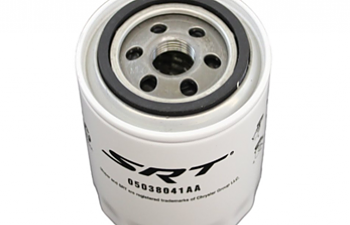
One of the best things that you can do for your Hemi engine is to change your oil at the factory recommended intervals, or sooner, and to use a high quality oil filter. Clean motor oil is important because if the oil were left unfiltered for a period of time, it could become saturated with tiny, hard particles that can wear surfaces in your engine. This dirty oil can wear the oil pump’s machined components and damage the bearing surfaces in the engine. Here is how an oil filter works. The outside is a metal can with a sealing gasket that allows it to be tightly held against the engine’s mating surface. The base plate of the can holds the gasket and is perforated with holes around the area just inside the gasket. A central hole is...
Oil Catch Cans
There has been much discussion if an oil catch can is necessary on a high performance engine. It is my opinion that the relatively modest price (usually about $100) is cheap insurance for your engine. First, let's go over what is currently happening in your engine without a catch can installed. All internal combustion engines that run off gasoline are 4-stroke engines. This means that the piston has to go up and down a total of 4 times to complete a cycle. The piston first goes down with the intake valves open creating a vacuum. This draws in the cool dense air for combustion. At the same time, fuel is injected into the cylinder. The intake valves close and then the piston rises up towards the top of the cylinder. This compression...

Members online

No members online now.

Members online

No members online now.

Trending content

Forum statistics

Threads
8,646
Posts
45,887
Members
4,578
Latest member
Dennis Donaldson
Back
Top