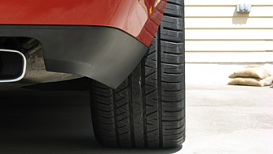
General Challenger

Active Exhaust
It’s a fact of life- cars make noise. Inexplicably, there are those in this world who build houses next to major freeways and then complain about the speed of the vehicles going past. There are those who build houses next to airports and complain about the excessive noise. Just as there are those people, there were those who decided that cars were too loud and needed to shut up! This presented car companies with a problem. Their engineers were telling them that for maximum efficiency, particularly in the horsepower department, the internal combustion engine needs a free flowing path for the exhaust gasses to escape. To reduce noise, on the other hand, requires a more restrictive path. For stock factory cars, auto manufacturers...
Anti-Sway Bars
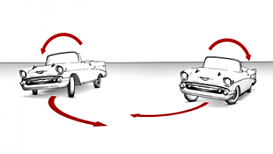
An anti-roll bar (roll bar, anti-sway bar, sway bar, or stabilizer bar) is a part of many automobile suspensions that helps reduce body roll during fast cornering or over road irregularities. It connects opposite (left/right) wheels together through short lever arms linked by a torsion spring. A sway bar increases the suspension's roll stiffness- its resistance to roll in turns, independent of its spring rate in the vertical direction. The first stabilizer bar patent was awarded to Canadian inventor Stephen Coleman in 1919. Anti-roll bars were unusual on pre-war cars due to the generally much stiffer suspension and acceptance of body roll. From the 1950s on, however, production cars were more commonly fitted with anti-roll bars...
All-Wheel Drive
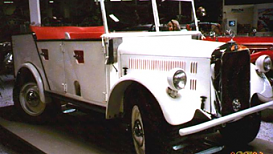
Four-wheel drive, 4WD, 4x4 ("four by four"), or AWD ("all-wheel drive") is a four-wheeled vehicle with a drivetrain that allows all four wheels to receive torque from the engine simultaneously. While many people associate the term with off-road vehicles and sport utility vehicles, powering all four wheels provides better control in normal road cars on many surfaces, and is an important part in the sport of rallying. The first application of four-wheel drive, occurred in 1893. In 1937, the Mercedes-Benz G5 and BMW 325 4x4 featured full time four-wheel drive, four-wheel steering, three locking differentials, and fully independent suspension. 1937 Mercedes G5 It was not until "go-anywhere" vehicles were needed for the military that...

Crankshafts
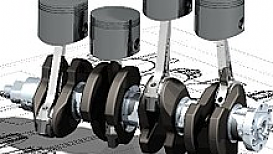
In simple terms, a crankshaft is a shaft driven by a crank mechanism, consisting of a series of cranks and crankpins to which the connecting rods of an engine are attached. It is a mechanical part able to perform a conversion between reciprocating motion and rotational motion. In a reciprocating engine, it translates reciprocationg motion of the piston into rotational motion. In order to do the conversion between two motions, the crankshaft has "crank throws" or "crankpins"- additional bearing surfaces whose axis is offset from that of the crank, to which the "big ends" of the connecting rods from each cylinder attach. A crankshaft is typically connected to a flywheel to reduce the pulsation characteristic of the four-stroke cycle...
Camshafts
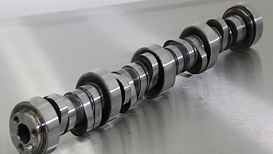
Camshafts are used to operate poppet valves. It consists of a cylindrical rod running the length of the cylinder bank with a number of oblong lobes protruding from it, one for each valve. The cam lobes force the valves open by pressing on the valve, or on some intermediate mechanism, as they rotate. Camshafts can be made out of several types of material. These include: Chilled iron castings: Commonly used in high volume production, chilled iron camshafts have good wear resistance since the chilling process hardens them. Other elements are added to the iron before casting to make the material more suitable for its application. Billet Steel: When a high quality camshaft or low volume production is required, engine builders and camshaft...
Tire Contact Patch
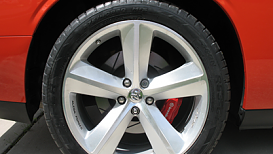
All vehicles are supported by a cushion of air contained in four flexible rubber tires. Each tire’s contact patch, or “footprint,” is a little smaller than a hand. As a result, not much of the tire's surface area is touching the ground, so the amount that does touch the ground must handle a great deal of weight (i.e., load) and force. These four patches create the traction which makes the vehicle go, stop and turn. Basically, they send feedback to the driver which helps to control the vehicle. The contact patch will vary in shape and size depending on the geometry of the tire, and this affects various performance characteristics of the tire. Tires with a higher profile or aspect ratio (i.e., the height of the sidewall is fairly large...
Rearview/Back-up Camera
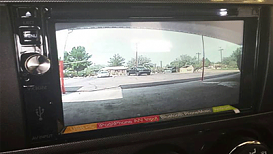
A backup camera (also called a reversing camera or rear view camera) is a special type of video camera that is attached to the rear of a vehicle to alleviate the rear blind spot and avoid a backup collision. The area directly behind vehicles has been described as a "killing zone" due to associated accidents. Backup cameras are usually connected to the vehicle’s head unit display. The first backup camera was used in the 1956 Buick Centurion concept car, presented in January 1956, at the General Motors Motorama. The vehicle had a rear-mounted television camera that sent images to a TV screen in the dashboard in place of the rear-view mirror. Later the 1972, the Volvo Experimental Safety Car (VESC) had a backup camera. However, the...
Mopar Engine Colors
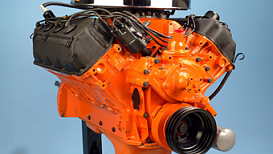
Automobile engines are usually painted bright colors, like red, orange or blue. This just isn’t for appearance. There is a practical purpose. Bright colors enable leaks to be spotted easily. Here is a list of engine colors (and paint codes) used by Mopar, from 1962 to 1971. Race Hemi Orange- Mopar P4120751 1962-1964 Max Wedge engines (413 and 426 Cross Ram) 1964-1965 426 Race Hemis Street Hemi Orange- Mopar P4349216 1966-1971 426 Street Hemis 1969-1971 High performance 383 and 440 engines 1970-1971 340 engines 1970 426 Turquoise- Mopar P4120752 (Medium blue-green color) 1962-1971 All B/RB big blocks. 1969 LA 340s. 1969-340 Red- Mopar P4349218 Late 1960s Poly 318 engines and 225 Slant 6 engines 1964-1969 All 273 engines...
Crumple Zones
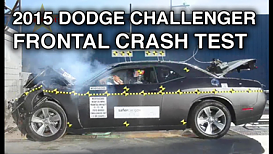
Crumple zones, crush zones, or crash zones, are a structural safety feature used in automobiles, to absorb the kinetic energy from the impact during a collision by controlled deformation. This energy is much greater than is commonly realized. A 4,409 lb. car traveling at 37 mph.,before crashing into a thick concrete wall, is subject to the same impact force as a front-down drop from a height of 47 ft. crashing on to a solid concrete surface. Increasing that speed by 50% to 56 mph. compares to a fall from 105 ft.- an increase of 125%. The specifics of crumple zone designs are usually proprietary information that auto makers are reluctant to divulge. They can vary widely, depending on the size and weight of the vehicle. Designers have to...
Development of Airbags
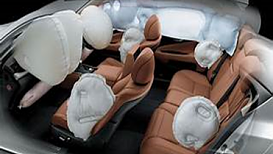
Airbags, like lap belts/shoulder belts, are a type of automobile safety restraint system designed to mitigate injury in the event of an accident. These gas-inflated cushions, built into the steering wheel, dashboard, door, roof, and/or seat of your car, use a crash sensor to trigger a rapid expansion of nitrogen gas contained inside a cushion, that pops out on impact to put a protective barrier between passengers and hard surfaces. The National Highway Traffic Safety Administration (NHTSA) says that frontal airbags have saved over 2,000 lives each year federal legislation mandated frontal air bags in 1998. Types of Airbags The two main types of airbags are designed for frontal impact and side impact. Advanced frontal airbag systems...
3.6L Pentastar Engine
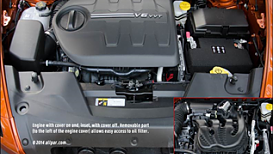
A popular cost-conscious alternative for Challenger owners to the 5.7L and 6.4L Hemi engines is the 3.6L Pentastar engine. It replaced the 3.5L engine, in 2012, and is rated at an impressive 305 horsepower and 270 lb.-ft. of torque, with 90% of its torque available from 1,800 to 6,350 rpm. Performance from this modern 6-cylinder engine actually exceeds some small blocks from the first muscle car era. Before the first aluminum block was cast, the new Pentastar V-6 benefited from more than 45,000 hours of computer analysis to optimize the design of the engine. Once assembled, the engines were thoroughly tested and evaluated on dynamometers and in vehicles. More than 12 million customer equivalent miles were logged on the dynos followed...
Dual Clutch Transmissions
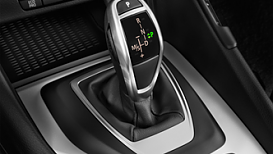
Most drivers know that cars come with two basic transmission types- manuals, in which the driver changes gears by depressing a clutch pedal and using a stick shift, and automatics, which shifts using clutches, a torque converter and sets of planetary gears. But there's also something in between that offers the best of both worlds- the dual-clutch transmission- also called the semi-automatic transmission, the "clutchless" manual transmission and the automated manual transmission. In the world of race cars, semi-automatic transmissions, such as the sequential manual gear box (SMG), have been a staple for years. But in the world of production vehicles, it's a relatively new technology- one that is being defined by a very specific...
What is a CVT Transmission?
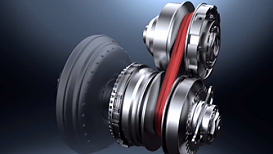
Some say you can't teach an old dog new tricks. But the innovative continuously variable transmission (CVT), which Leonardo da Vinci conceptualized more than 500 years ago is now replacing planetary automatic transmissions in some automobiles. Since the first Toroidal CVT patent was filed in 1886, the technology has been refined and improved. Today, several car manufacturers, including General Motors, Audi, Honda, Hyundai and Nissan, are designing their drivetrains around CVTs. Cars with CVTs, sometimes called shiftless transmissions, have been common in Europe for years. But it's taken a while for the technology to gain a foothold in the U.S.. The first production automobile to offer a CVT in the United States was the Subaru Justy in...
Still not quite sure how to post an article yet, but Finally: Why manual transmission is better than an automatic https://tremec-blog.com/10-reasons-a-manual-transmission-is-better-than-an-automatic/ Not so long ago, it was widely accepted that a true performance car had a manual transmission. In fact, some performance cars were only available with a manual transmission. Well, in the great age that is the 21st century, things have changed. Now the beloved third pedal is being replaced with paddle shifters attached to the steering wheel and a network of passionless electronics connected to them that signal the transmission what to do when the driver commands it. But we’re proud to proclaim that the manual transmission is far from dead...
Pro Stock Record Holders
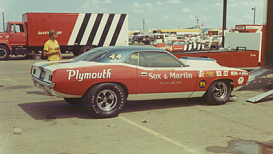
Pro Stock quarter mile drag racing times have dramatically decreased over the decades, since the class was established in 1970. This has been the result of tremendous advances in technology. To determine who is the fastest competitor, forty-nine years ago, NHRA instituted the Mello Yello Drag Racing Series. The champion is determined by a point system where points are given according to finishing placement and qualifying effort. The season is divided into two segments. After the first 18 races, the top 10 are locked in and compete in the last six races with the difference in points greatly minimized. Here are the winners, by decade. (Note the decrease in ¼ mile times): 1970- Ronnie Sox (Plymouth ‘Cuda)- 9.85 sec. (Note- Incredibly...
Fuel Delivery Systems
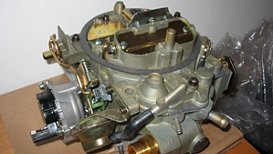
A carburetor was the common method of fuel delivery for most US-made gasoline engines until the late 1980s, when fuel injection became the preferred method. This change was dictated by the requirements of catalytic converters and not due to an inherent inefficiency of carburation. Basically, a carburetor consists of an open pipe through which the air passes into the inlet manifold of the engine. The pipe is in the form of a venture- it narrows in section and then widens again, causing the airflow to increase in speed in the narrowest part. Below the venturi is a butterfly valve called the throttle valve- a rotating disc that can be turned end-on to the airflow, so as to hardly restrict the flow at all, or can be rotated so that it...
Crash Test Dummies
A crash test dummy is a full-scale anthropomorphic test device (ATD) that simulates the dimensions, weight proportions and articulation of the human body during a traffic collision. Dummies are used by researchers,automobile and aircraft manufacturers to predict the injuries a person might sustain in a crash. Modern dummies are usually instrumented to record data, such as velocity of impact, crushing force, bending, folding, or torque of the body, and deceleration rates during a collision. There is constant need for testing because each new vehicle has a different design. The need for a means of analyzing and mitigating the effects of motor vehicle accidents on humans was felt soon after commercial production of automobiles began in...
Tire Speed Ratings
Tire speed ratings first originated in Europe in the 1960s, as a way to make sure increasingly faster vehicles were equipped with appropriate safe tires. These early speed ratings set the foundation for the current speed rating system used by the DOT and tire manufacturers. Every tire approved for highway use by the Department of Transportation comes with a particular speed rating. The speed rating is a letter corresponding to the maximum safe speed at which a tire can be driven, as determined by laboratory testing. During laboratory testing, a technician places a properly inflated tire into a large diameter drum. The drum rotates the tire for 10-minute intervals at increasingly higher speeds. The technician verifies the tire’s...
How the EPA Tests Vehicles for Mileage
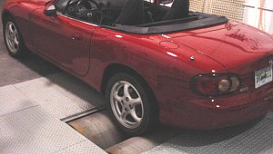
Fuel economy for vehicles (city, highway and combined) is measured under controlled conditions in a laboratory using a series of tests specified by federal law.The results are displayed for the consumer on the "new car window sticker." Estimating MPG with Laboratory Tests In the laboratory, the vehicle's drive wheels are placed on a machine called a dynamometer. The "dyno" simulates the driving environment much like an exercise bike simulates cycling. Engineers adjust the amount of energy required to move the rollers to account for wind resistance and the vehicle's weight. On the dyno, a driver runs the vehicle through standardized driving routines called cycles or schedules. These cycles simulate "typical" trips in the city or...
What is Hydroplaning?
The term hydroplaning is commonly used to refer to the skidding or sliding of a car’s tires across a wet surface. Hydroplaning occurs when a tire encounters more water than it can scatter. Water pressure in the front of the wheel pushes water under the tire, and the tire is then separated from the road surface by a thin film of water and loses traction. The result is loss of steering, braking and power control. Rubber tires have tread (grooves) that are designed to channel water from beneath the tire. This creates higher friction with the road surface and can help prevent or minimize instances of hydroplaning. When does Hydroplaning Occur? Hydroplaning can occur on any wet road surface, however, the first 10 minutes of a light...

Members online

No members online now.

Members online

No members online now.

Trending content

Forum statistics

Threads
8,646
Posts
45,887
Members
4,578
Latest member
Dennis Donaldson
Back
Top